Sleep Science & Mattress Guide
Dunlop Latex Explained: Feel, Firmness, and How to Choose
Dense yet springy, supportive without feeling inert, Dunlop latex has a character all its own. Understanding how it is made—and how it behaves as one part of a complete mattress—can make it easier to decide whether this natural latex construction belongs in your bedroom.
Mattress materials have a language of their own. There are terms that describe what goes into a bed, terms that explain how it is assembled, and words—“firm,” “buoyant,” “responsive”—that attempt to translate a private, physical sensation into a specification. Dunlop latex sits at the intersection of all three. It is a method of making latex foam, a material used in mattress layers, and a distinct-feeling surface that many sleepers describe as resilient and grounded.
That description is a beginning, not a guarantee. A Dunlop latex mattress can feel quite different from another, depending on its firmness, thickness, layer arrangement, cover, and the foundation beneath it. The useful question is not simply whether Dunlop is comfortable. It is whether the particular construction creates a sleep surface that feels comfortable and supportive to you.
What is Dunlop latex?
Dunlop latex is latex foam produced through a process in which latex is whipped into a frothy mixture, placed in a mold, and vulcanized. Vulcanization uses heat to transform the latex mixture into an elastic, stable foam. The resulting material contains a network of air spaces and latex, creating a layer that can compress under weight and rebound when that weight is removed.
The latex may come from natural rubber, synthetic rubber, or a blend, so the word “Dunlop” alone does not establish the material’s source. It identifies the production method, not an automatic guarantee of composition, organic status, or environmental credentials. When evaluating a mattress described as natural latex, look for clear disclosure of the latex content and any relevant certifications. A product label can use specific terms in different ways, so check what the manufacturer says is certified and which parts of the finished product that certification covers.
Dunlop is often compared with Talalay, another process used to make latex foam. The two methods have different production steps and can result in foams with different characteristics, but shoppers should resist turning that distinction into a simple rule that one is always softer, firmer, or better. The feel of a finished layer depends on its formulation, density, firmness, thickness, and role in the mattress. The details of the individual construction matter more than a process name considered in isolation.
The feel: buoyant, steady, and responsive
One of the most commonly noted qualities of Dunlop latex is its buoyancy. Rather than sinking slowly and closely around the body, as some sleepers experience with memory foam, latex tends to respond more promptly to movement. When you shift position, the surface generally rebounds instead of leaving a lingering impression. That lively response can make a bed feel easier to move across, though no material feels identical to every sleeper.
Dunlop is also frequently described as having a substantial or grounded feel. Its structure can feel dense beneath the body, offering a sense of stable support while still compressing at points of contact. Think of it as a balance between give and lift: the surface yields, but it does not necessarily feel enveloping. For sleepers who prefer a mattress that responds rather than slowly moulding around them, that quality may be appealing.
“Dense,” however, should not be confused with “hard.” A soft Dunlop layer can cushion the body; a firm one can feel much more resistant. Nor does a dense impression tell you by itself whether a mattress provides the right support. Comfort depends on how the entire system responds to your body, including the comfort layer, transition layers, support core, cover, and base. The same latex layer can also feel different beneath a quilted cover than it does under a thinner, stretchier fabric.
Latex’s springy response may be especially noticeable when changing sleeping positions. Combination sleepers often pay attention to this quality because they move between their side, back, and stomach during the night. But a mattress that feels lively to one person may feel too buoyant to another. If you prefer a softer, more contouring sensation, a latex surface may take some adjustment—or a different comfort-layer arrangement may be more suitable.
Firmness is not the same as support
Firmness is the first sensation many people notice when lying down. It describes how yielding or resistant the surface feels. Support is broader: it concerns how the mattress holds the body in a comfortable, reasonably aligned position across the night. A firm mattress is not automatically supportive for every sleeper, and a softer one is not automatically unsupportive. The relationship between the sleeper and the construction is what counts.
Firmness descriptions are not perfectly standardized across manufacturers. One brand’s “medium” may feel firmer or softer than another’s, and individual perception varies with body shape, weight distribution, preferred sleeping position, and personal sensitivity to pressure. A label can help narrow a search, but it cannot substitute for understanding the mattress’s layer design or, where possible, trying it under realistic conditions.
In general, side sleepers often look for enough surface cushioning to ease pressure around the shoulders and hips. Back sleepers may prioritize a balanced combination of contouring and support through the torso. Stomach sleepers commonly prefer a surface that does not allow excessive sinking around the midsection. These are starting points rather than rules: body proportions, comfort preferences, and any particular physical concerns can change what feels best.
When considering Dunlop latex, ask how the layer’s firmness works with the layers above and below it. A softer upper layer can create initial cushioning over a firmer support layer. A firmer comfort layer may feel more direct, particularly when it is thin or paired with a taut cover. The same firmness of latex can contribute differently depending on its position in the mattress.
How mattress layers shape the experience
A mattress is not a single material acting alone. It is a composition. The uppermost layer influences the first impression; layers beneath it influence how the body settles and how movement is supported. A latex mattress might use one continuous latex layer, several latex layers with different firmnesses, or latex combined with other materials. Each arrangement changes the way the bed feels.
- Comfort layer: The top layer helps determine initial softness, pressure relief, and how closely the surface responds to the body.
- Transition layer: A middle layer can create a gradual change between the softer surface and the firmer support beneath it.
- Support core: The base of the mattress provides the main foundation for the layers above and influences the overall stability of the bed.
- Cover and quilting: Fabric, quilting, and padding alter the first touch and may soften or moderate the feel of the latex underneath.
- Foundation: The bed frame or foundation can affect how evenly the mattress is supported, so follow the mattress maker’s requirements.
Layer thickness matters, too. A thin latex comfort layer can feel quite different from a deeper one because it allows less distance for the body to compress into the material before encountering the firmer layer beneath. A mattress with multiple layers may also allow the maker to tune softness and support more precisely. Rather than focusing on a single headline claim, look for a clear description of the materials, their order, and their thicknesses.
Dunlop and Talalay: a useful distinction
Shoppers researching natural latex organic mattresses will often encounter both Dunlop and Talalay. Both are latex foams, but they are made using different processes. Talalay production includes additional steps that create a different foam structure. Those manufacturing differences can influence feel, but they do not, on their own, tell you which mattress is the better choice.
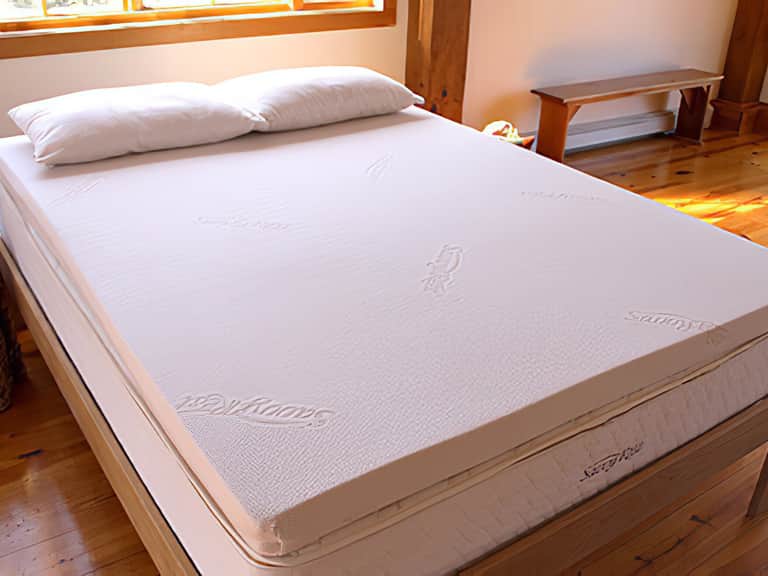
For example, a latex topper made with Talalay can provide a helpful point of comparison for someone exploring latex comfort. The Savvy Rest Vitality Latex Mattress Topper is described as a three-inch layer of soft natural Talalay latex in an organic cotton stretch-knit cover. It is not a Dunlop product, but its construction illustrates how the type and firmness of a latex layer, as well as its thickness and cover, can shape the surface feel. A topper may change comfort, but it cannot repair a mattress whose support structure has deteriorated.
Comparisons are most useful when they stay specific. Instead of relying on shorthand such as “Dunlop is firm” or “Talalay is soft,” compare the stated firmness, layer thickness, overall construction, and available testing or return policies. If you can visit a showroom, spend enough time on each surface to notice pressure, ease of movement, and how your body settles. A quick sit on the edge is not a meaningful test of a night’s sleep.
Choosing a Dunlop latex mattress for your sleep position
Start with the way you sleep most often, then consider how much cushioning you like. Side sleepers may want to pay particular attention to shoulder and hip comfort. If a mattress feels too firm in those areas, a softer top layer may be worth exploring. Back sleepers can compare how evenly the surface supports the body without creating uncomfortable pressure. Stomach sleepers may want to be especially mindful of excessive sinking through the middle of the bed.
People who change positions should consider how easily the mattress responds as they move. Dunlop’s buoyant quality can feel convenient to some combination sleepers, while others may prefer a more enveloping surface. Couples may also want to assess motion transfer and whether both people can find a comfortable position. Latex’s responsiveness does not guarantee a particular result for every mattress; the complete design and the sleepers’ preferences remain important.
Body weight and shape affect how deeply a person compresses a mattress. Two people can lie on the same bed and experience different firmness because their weight is distributed differently. This is one reason that online firmness ratings and broad position-based recommendations should be treated as guidance, not verdicts. If a retailer offers a home trial, read the terms carefully, including the length of the trial, any required break-in period, and return or exchange conditions.
What to check before you buy
A considered purchase begins with transparent specifications. Look beyond the word “latex” and ask what the foam contains, how the layers are arranged, and whether the mattress uses Dunlop, Talalay, or a combination. If “natural” or “organic” appears in the description, check the scope and meaning of the claim instead of assuming that every component has the same status. A mattress can include a latex layer alongside a cover, quilting, adhesives, or other materials that have their own specifications.
- Composition: Confirm whether the latex is natural, synthetic, or blended, and look for detail about other mattress components.
- Layer layout: Note the thickness and position of each layer, especially the comfort layer and support core.
- Firmness options: Compare the maker’s descriptions carefully, remembering that firmness labels are not universal.
- Cover construction: Consider whether quilting or padding may soften, warm, or otherwise change the surface sensation.
- Care and handling: Check the care instructions and practical requirements for rotating, lifting, or moving the mattress.
- Trial and warranty terms: Understand what is covered, what is excluded, and what conditions apply to a return or warranty claim.
- Foundation compatibility: Make sure the frame or base meets the manufacturer’s support requirements.
Weight is another practical consideration. Latex mattresses can be substantial, which may make delivery, repositioning, or changing bedding more demanding. If you live in a walk-up, have narrow hallways, or expect to move soon, check the mattress’s dimensions and handling requirements in advance. A mattress is part of a home’s daily routine, not merely a showroom decision.
Natural, organic, and responsible claims
Interest in natural latex organic mattresses often comes from a desire to understand material sourcing and manufacturing. Those concerns are worth investigating, but terminology can be complicated. “Natural latex” usually refers to latex derived from rubber-tree sap, yet finished foam and mattresses may contain other ingredients and components. “Organic” is a claim that should be supported by relevant certification and explained clearly.
Read certification information at the level of detail provided. Find out whether it applies to the latex foam, the textile cover, or the finished product, and avoid assuming that a certification for one component covers everything in the mattress. When information is unclear, ask the manufacturer for written specifications. Clear answers are more useful than a broad, attractive label.
Is Dunlop latex right for you?
Dunlop latex may be worth considering if you like a responsive, buoyant surface and want a mattress construction that can combine cushioning with a steady feel. Its appeal is not that it has one universal firmness or one perfect sleeping profile. It is that the material can be used in different ways, allowing manufacturers to create a range of sensations through layer selection and design.
It may be less immediately appealing if you strongly prefer the slow, close contouring associated with some memory foams, or if you find a springy surface distracting. Even then, preferences are personal and can depend on the exact mattress. A quilted cover, a softer latex layer, or a different layer arrangement may make a latex mattress feel unlike the image suggested by its material name.
The most reliable approach is to compare complete constructions, not isolated claims. Notice whether your shoulders and hips feel comfortable, whether your body seems supported in your usual sleep position, and whether turning feels easy. Give yourself time to assess the surface under realistic conditions, and use a trial period thoughtfully if one is available. The right mattress is not the one with the most compelling vocabulary. It is the one whose materials and design work quietly, night after night, for the person sleeping on it.
The bottom line
Dunlop latex is made by whipping latex into foam, molding it, and vulcanizing it. Its characteristic reputation is for a buoyant, responsive feel that can also seem dense and supportive. But the production method does not dictate a single level of firmness, and material names cannot replace the more revealing details of a mattress: its layers, thicknesses, cover, foundation, and suitability for your body and sleep habits.
Approach the choice with curiosity rather than assumptions. Compare specifications, distinguish the latex process from claims about material sourcing, and consider how the entire mattress feels together. That is where the answer to whether a Dunlop latex mattress is right for you really begins.